My Ex-Husband Thought Sitting Beside Me on the Flight Would Embarrass Me… Then Three Little Boys Rushed Out of a Bentley Yelling, ‘Mom!’

Five years after my divorce, my billionaire ex-husband deliberately sat beside me on a first-class flight just to remind me of everything our marriage had become. He thought I was alone. He thought I had spent years thinking about how everything ended. What he didn’t know was that when we landed in Chicago, three little boys would come running toward me from a waiting Bentley—and the truth he had been missing for five years was about to change everything he believed.
My name is Emma Winters, and I became an environmental scientist because I believed in systems.
Not the corporate kind—the real kind. The kind where every element depends on every other element in ways that aren’t always visible until something breaks. Carbon cycles. Watershed dynamics. The invisible architecture of living systems that sustain everything else without announcement or credit.
I spent twelve years studying the way things connect before I met Blake Harrington, and I spent four years married to him before I understood that the principles I applied to ecosystems also applied to marriages: every system has a breaking point, and most collapses don’t announce themselves until they’re already irreversible.
The morning I found myself sitting in a first-class seat at O’Hare waiting for a flight back to New York, I was not thinking about Blake. I was thinking about the conference I had just attended—three days of climate modeling presentations and late-evening dinners with colleagues I only saw twice a year—and about the fact that I had promised my boys I would bring them back the deep-dish pizza from the place near my hotel, which I had successfully done, and which was currently occupying the overhead bin in a manner the flight attendant had accepted with the resigned grace of someone who has seen stranger things.
I was thinking about none of this when the first-class cabin door opened and Blake Harrington walked through it.
Some people, when you haven’t seen them in years, look like strangers who merely resemble themselves. The version of them you carry in memory has softened or sharpened or simply fossilized into something that no longer matches the living person.
Blake did not look like a stranger.
He looked exactly like himself, which was, in many ways, worse.
The same particular way of moving—unhurried but purposeful, the gait of someone who has never had to consider whether he belonged in a room. The same dark hair, slightly longer than he used to wear it. The same jaw, which I had once described to Maya—my best friend and, more relevantly for this story, my personal attorney and the woman currently raising my boys on the other end of a phone call I had abruptly ended the moment I saw him board—as “architecturally aggressive.”
Maya had told me I thought too much like a scientist.
She had not been wrong.
Blake’s eyes found mine before I had decided what expression to arrange.
For a half-second, we were simply two people recognizing each other across a small space, before history arrived in a rush and rearranged everything.
“You’ve got to be kidding me,” he said.
I closed my book. “Trust me, Blake. If I’d known you were on this flight, I would’ve driven.”
A few nearby passengers looked over with the restrained interest of first-class travelers, which is to say they looked while pretending very convincingly not to.
The flight attendant appeared at Blake’s elbow. “Mr. Harrington, your seat is—”
“I know where my seat is.” He glanced at the seat beside me—the window seat, currently occupied by nothing but the jacket I had draped there—and then at the several other empty seats in the cabin.
He sat down next to me.
“There are other places you could sit,” I said.
“I know.”
“So why here?”
A faint, infuriating smile. “Five years of silence. I figured we should catch up.”
I turned to look out the window at the tarmac and thought, briefly and without real malice, about what it would feel like to be anywhere else on earth.
“You always confused arrogance with confidence,” I said.
“And you always confused silence with honesty.”
My stomach tightened.
Five years, and he still knew exactly where to press.
I should tell you what happened, because the version Blake believed and the version that was true were not the same story, and the gap between them had cost us everything.
Blake and I met at a clean-energy summit in San Francisco when I was thirty-one and he was thirty-five. I was presenting research on atmospheric carbon sequestration that his company had partially funded without his direct knowledge, which meant that our introduction had an accidental quality to it that neither of us had manufactured—he was genuinely surprised by my work, and I was genuinely surprised that the CEO of a company that had been, in my experience, reliably difficult to reach was standing in front of me looking almost humble.
Almost.
We talked for three hours. We had dinner the following week. We were in a relationship within the month, which was, by the standards of my generally cautious personal life, approximately the speed of light.
The thing about Blake that most profiles got wrong—and there were many profiles, because he was photogenic and quotable and his company made for good copy—was the thing about his certainty. Articles tended to frame his decisiveness as a strength, which it was, professionally. He could assess a situation and commit faster than anyone I had ever met, and in business, that quality built empires.
In marriage, it built something else.
Because the same mechanism that allowed him to identify an opportunity and move before the moment passed also allowed him to identify a threat—real or perceived—and act before the full picture had assembled itself.
He trusted his first read. He had been right about it so many times that he had stopped questioning it.
He was wrong about me.
The messages that ended our marriage were from a colleague named Dr. Patrick Osei.
Patrick was a climatologist at MIT who had been my academic mentor during my postdoctoral work and had remained, for the ten years since, one of my closest professional collaborators and one of my most trusted friends. He was also, in the tradition of many long friendships between colleagues who had spent years working together under pressure, someone with whom I communicated in a shorthand that read, if you didn’t know the context, in ways it wasn’t.
The messages Blake found were about a project.
A project that, for reasons that were genuinely complicated and that I had been trying to find the right moment to explain, I had been keeping from him.
Not because it was secret. Because it was personal in a way I hadn’t figured out how to articulate yet, and because “the right moment” is something that, when you’re in a difficult marriage trying to protect a fragile peace, keeps receding into an endless horizon of not-yet.
Patrick and I had been developing a proposal for an independent research institute—small, focused, designed to conduct the kind of long-horizon climate research that corporate funding couldn’t support because it didn’t produce results on quarterly timelines. The kind of research that might not show meaningful data for a decade but that mattered enormously to the actual problem of the planet.
I had been keeping it from Blake because I knew it would mean, eventually, leaving his company. And leaving his company—which I had helped build, whose foundational technology bore my intellectual fingerprints in ways that the public record didn’t fully reflect—was a conversation that had so many emotional layers I had been unable to find the starting point.
So I had waited.
And while I waited, Patrick and I had exchanged messages that talked around the project in the oblique, context-dependent language of people who had worked together for a decade—references to “the thing we’re building,” to “when we finally make the break,” to “keeping this close until the time is right.”
Blake found those messages on a Saturday evening when I had left my phone on the kitchen counter to charge while I made dinner.
He read them before I knew he had my phone.
And his first read—fast, certain, catastrophically wrong—was that I was having an affair.
“You disappeared,” Blake said, somewhere over Indiana.
We had been quiet for almost an hour. The flight was smooth. The cabin was settled into the specific calm of a long flight in which everyone has arranged themselves into their preferred positions and begun the business of existing in suspended transit.
“I moved on,” I said.
“To where?”
“Chicago. My research institute.”
Something crossed his face. “The Winters-Osei Institute.”
I turned to look at him. “You know about it.”
“I know about most things that involve you and clean energy.” He paused. “It’s doing important work.”
“I know.”
“Patrick Osei runs the computational modeling division.”
“He does.”
“He’s married. Three kids. I heard he named his daughter Emma.”
I looked at him for a long moment. “Yes.”
The silence that followed had a different quality than the previous ones.
“I should have let you explain,” Blake said. It came out evenly, without the drama of confession, which made it somehow more significant.
“Yes,” I said again. “You should have.”
“I didn’t want to hear that I was wrong.”
“I know.”
“That’s not an excuse.”
“No,” I agreed. “It’s not.”
Outside the window, the flat geometry of the Midwest scrolled past far below—fields and roads and the occasional glint of water. From this altitude, it looked orderly. Everything looked orderly from sufficient distance.
“You didn’t take anything,” Blake said. “In the settlement. Your attorneys offered you almost nothing and you accepted.”
“I didn’t want anything that was yours.”
“Half of it was yours. The patents alone—”
“I didn’t want them.” I looked at him. “I wanted the work to keep existing in the world and I wanted to be done with the part of my life that was making me unhappy. Those were my two priorities.”
“And were you? Unhappy?”
The question landed in a more vulnerable register than I expected from him, which meant either that five years had changed him in ways I hadn’t anticipated or that the altitude was doing something strange to my judgment.
“Toward the end,” I said honestly. “Not always. Not at the beginning.”
He was quiet.
“I was unhappy too,” he said finally. “I want you to know that. Not because it excuses anything. Just because it’s true.”
I nodded. I believed him. Unhappiness in a marriage is rarely one-sided, and ours had been built, in retrospect, on a foundation that prioritized the external version of itself—the magazine covers, the shared ambition, the perfect-on-paper symmetry of two people who were changing the world together—over the interior work of actually knowing each other.
We had been very good at being a couple in public.
We had been less practiced at being two people alone in a room.
The plane began its descent into O’Hare ninety minutes later.
I texted Maya as we started dropping through clouds: Landing in 20. How are they?
She responded immediately, the way Maya always responded, with the efficiency of a woman who had learned to communicate in complete thoughts at the speed of text messages: Perfect. Fed. Argued about whose turn it was on the iPad. Theo won. They’re in the car. See you at arrivals.
I smiled at my phone.
“Something good?” Blake asked.
“Yes,” I said. “Something very good.”
I did not explain.
The arrivals area at O’Hare on a Tuesday afternoon has the specific energy of a place designed entirely for transition—people ending journeys and beginning others, the particular emotional intensity of arrivals and departures compressed into a space of sliding doors and concrete pillars and the periodic announcement of flights over the PA system.
I had navigated it hundreds of times. It was completely ordinary.
Nothing about the next few minutes would be ordinary.
Blake walked out of the terminal beside me, not by design but by the natural consequence of moving in the same direction at the same pace, and we stepped through the sliding doors into the gray November air of Chicago, and the world outside was exactly what it always was—black SUVs, taxis, a line of drivers holding signs, exhaust and cold wind and the ambient noise of a major airport doing its major airport business.
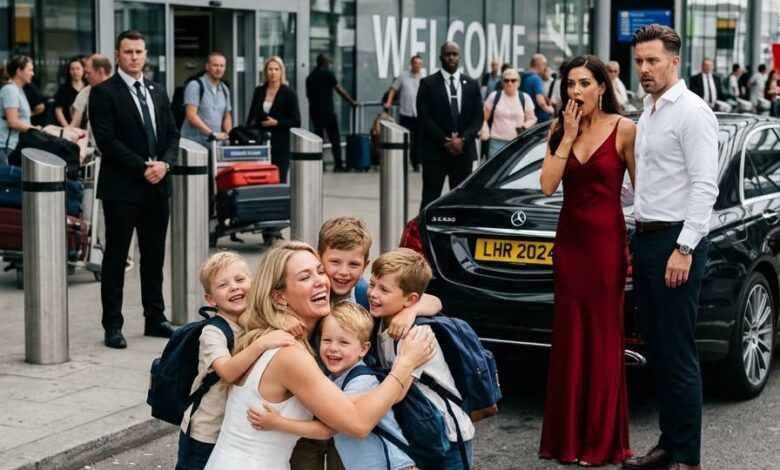
And then the black Bentley pulled forward.
I knew the car. Maya had borrowed it from her firm’s car service, which was the kind of thing Maya did without a second thought because she operated in a world where black Bentleys were unremarkable. The rear door opened from inside before the car fully stopped, in the particular way of small children who have been waiting long enough that patience has become physically impossible.
“Mom!”
Three voices, imperfectly synchronized, arriving all at once.
Oliver came first—he was seven, the oldest, and he ran with the directional certainty of a child who has identified his target and is not going to be distracted by anything short of an act of God. He hit me at full speed and I caught him the way I had been catching him for six years, adjusting my balance automatically, laughing at the impact.
Finn was six, more cautious than his brother but no less enthusiastic, and he grabbed my free hand with both of his and said, “We’ve been waiting forever. Maya wouldn’t let us have more than one piece of gum.”
Theo was four, and Theo’s approach was less strategically sound than his brothers’ but more emotionally comprehensive—he wrapped both arms around my left leg and pressed his face against my coat and said nothing at all, which was Theo’s way of expressing the things that were too large for words.
I crouched down as far as the logistics of three children allowed and gathered them in, and the cold air and the airport noise and the ordinary chaos of arrivals fell away entirely for a moment.
“Hey, my sweet boys,” I said.
Then I looked up.
Blake was standing six feet away, and his face was—
I had seen Blake Harrington maintain composure in situations that would have broken most people. I had watched him handle a hostile board meeting, a catastrophic equipment failure that threatened a major contract, a public scandal involving a company executive, all with the particular stillness of someone whose identity is organized around being unshakeable.
He was not still.
He stood on the arrivals curb at O’Hare in the gray November cold, and his face had gone through everything—shock, recognition, calculation, and then something underneath all of it that I had not seen in five years and had mostly stopped hoping to see again.
Because Oliver was looking up at him with my green eyes in Blake’s face.
Because Finn had Blake’s jaw and Blake’s dark hair and the particular way of standing slightly sideways that Blake did when he was uncertain about something—a thing I had once found endearing and had apparently passed along genetically without intending to.
Because Theo was still pressed against my leg, but he had turned his face to look at the stranger, and Theo had the most Harrington face of all three of them, the face that his grandmother—Blake’s mother, Eleanor, who had sent birthday cards every year to an address she’d found through Maya—had wept over in a photograph I had shared three years ago.
Nobody spoke.
Oliver, who was seven and did not yet have the social framework to understand why adults sometimes stop working, looked between me and Blake with the frank assessment of a child deciding whether something is interesting.
“Mom,” he said, “who is that?”
I stood up.
“Someone I used to know,” I said.
Blake took one slow step forward. Then another. His voice, when it arrived, was barely working.
“Emma.”
I looked at him. I had rehearsed this moment—not often, not obsessively, but in the occasional late-night version of it that arrived without invitation—and in every rehearsed version I had been calm. Controlled. Prepared.
I was not entirely any of those things.
“You should probably—” I started.
“How old,” he said. Not a question. A man doing arithmetic he could not stop doing.
“Oliver is seven,” I said. “Finn is six. Theo is four.”
His breath came out slowly.
“You were pregnant,” he said. “When the divorce—”
“I didn’t know yet. I found out after.”
“You didn’t tell me.”
I looked at him steadily. “You had made it very clear that you didn’t want to hear anything I had to say.”
The words landed without cruelty, which was how I had meant them—not as an accusation but as a fact, the kind that can be acknowledged without requiring a verdict about who was worse.
Oliver had lost interest in the adult exchange and was investigating the Bentley’s wheel well with the scientific focus of a child who has inherited his mother’s empirical curiosity. Finn was still holding my hand but watching Blake with the narrow assessment of a six-year-old who is deciding whether to trust someone. Theo had migrated from my leg to standing slightly behind it.
Maya appeared from the driver’s side of the car, phone in hand, looking between me and Blake with the expression of a woman who is taking in a great deal of information and processing it with impressive speed.
“Blake,” she said, not warmly but not without civility. Maya was always precise in her courtesies.
“Maya.” He looked at her. “You knew.”
“I’m her attorney,” Maya said. “I know everything.”
“You could have—”
“No,” Maya said simply. “I couldn’t have. That wasn’t mine to do.”
Blake looked back at me.
There were a hundred things in his expression—regret and wonder and the beginning of something that looked like grief for time that couldn’t be returned—and I looked at all of it and felt the complicated mixture of things that I had been carrying for five years: anger that had softened into something less sharp, sadness that had transformed into something more architectural, the persistent, unresolved question of what might have been if one of us had been different.
“They don’t know me,” he said.
“No,” I said. “They don’t.”
“Can I—” He stopped. Started again. “Is there a way to—” He looked at Oliver, who had now moved on from the wheel to studying the gap between the curb and the car with the same focused attention. “I don’t know what I’m asking.”
“I think you’re asking if it’s too late,” I said.
He looked at me.
“For them?” I shook my head. “They’re four and six and seven, Blake. It’s not too late for them. Children are more elastic than we think. They can accommodate new things if the new things are consistent and honest and present.”
“And for—” He stopped.
“One thing at a time,” I said. Not a door closing. Not a door opening. Something more like the acknowledgment that the door existed and we were both standing in front of it.
Maya had organized the boys back into the car with the efficiency of someone who had been doing this for years, which she had—she was their unofficial aunt and most reliable presence outside of me, and they trusted her completely. I could hear Oliver explaining something about wheel wells to Finn in a tone of great authority.
“They’re extraordinary,” Blake said quietly.
“Yes,” I said. “They are.”
“They have your—”
“They have both of us,” I said. “Whether we planned it or not.”
He stood with that.
We exchanged numbers in the way of two people who understand that something has shifted irrevocably and that the shape of what comes next is not yet clear.
Blake’s car—the black SUV with the security detail that I remembered from our life together—waited at the curb. Mine waited too. We were both going in different directions, as we had been for five years, as we might continue to be.
But not entirely.
“The messages,” Blake said, before I reached the car. “The ones from Patrick.”
I turned.
“They were about the institute,” he said. Not a question. The arithmetic again.
“Yes.”
“You were leaving my company.”
“I was building something of my own,” I said. “Something I believed in. Something that needed to exist independent of you.”
He absorbed that. “And you didn’t know how to tell me.”
“I didn’t know how to tell you in a way that you wouldn’t experience as a betrayal,” I said. “Which was its own problem—that I was so afraid of how you’d receive something legitimate and important to me that I hid it instead of trusting you with it.”
“That was my fault,” he said.
“It was both of ours,” I said. “That’s the honest version.”
He nodded slowly.
“I’d like to meet them properly,” he said. “When you’re ready. When they’re ready. However that needs to happen.”
“I’ll have Maya reach out,” I said. “She’ll handle the logistics. She’s very good.”
Something shifted in his expression—almost a smile, the first genuine one since he had walked onto the plane. “She terrifies me.”
“Good,” I said. “That’s how it should be.”
I got into the car.
Oliver immediately demanded to know who the man on the curb was, with the persistence of a seven-year-old who had not forgotten that he had asked this question and not received what he considered an adequate answer.
“Someone who is going to be part of our lives,” I said.
“Who is he though?”
I looked out the window as the car pulled away. Blake was still standing at the curb, watching. In the gray November light he looked like someone at the beginning of something—uncertain, slightly undone, trying to locate his footing in a landscape that had just rearranged itself entirely.
I recognized that feeling.
I had felt it for years.
“He’s someone who made a mistake,” I told Oliver, “and who is going to have to work very hard to make it right.”
Oliver considered this with the moral seriousness of the very young. “Is he sorry?”
I thought about the way Blake had looked at them on the curb—all that certainty temporarily dissolved, replaced by something more human and more fragile.
“Yes,” I said. “I think he finally is.”
Finn accepted this. Theo had fallen asleep against my arm.
Oliver looked out the window for a moment, then looked back at me with the expression he got when he was working something out.
“Will we see him again?”
“Yes,” I said.
“Soon?”
“I don’t know. But yes. Eventually.”
Oliver seemed to process this with the flexibility of someone for whom the future is still mostly hypothetical and therefore not yet frightening.
“Okay,” he said, and went back to the iPad.
I pressed my lips to the top of Theo’s sleeping head and watched Chicago move past the windows—the gray lake, the November streets, the city doing what cities do in the quiet middle of an ordinary Tuesday that had turned out not to be ordinary at all.
My phone buzzed. Maya, from the front seat, where she was pretending not to have followed every word of the conversation.
You okay?
I looked at my three boys—Oliver absorbed in his game, Finn watching the city, Theo warm and heavy against my side.
Yeah, I typed back. I really am.
And the car moved forward through the November afternoon, toward home.
THE END