In Front of His Entire Family, My Husband Claimed I Baby-Trapped Him—Then My MIL Said Something That Left Me Speechless

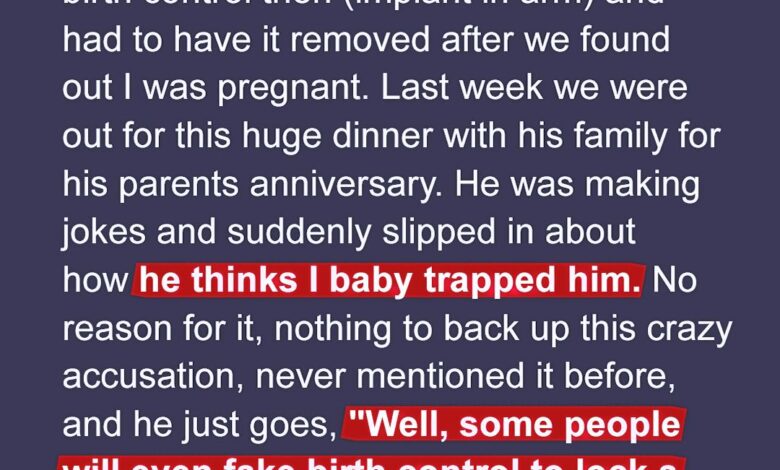
During a family dinner with Jonah, his parents, and their three kids, Jonah made a shocking remark:
“I mean, let’s be honest… Elena baby-trapped me, didn’t she?”
He laughed, expecting everyone to join in, but the comment hung in the air. His mother, Sylvia, gasped in surprise, and his father, Alan, looked confused. The room went silent except for their eight-year-old son, Noah, who remained oblivious as he talked about a lizard he had seen at school.
Jonah continued, grinning, “You know… we were together for years—no pregnancy—and then, boom! One surprise baby!”
No one laughed. Elena, the narrator, felt a wave of confusion, embarrassment, and anger crash over her. Jonah’s casual remark had turned a normal family dinner into a tense moment, forcing her to confront years of assumptions and unspoken feelings.
He thought he was being funny, maybe even endearing, as if this were some charming “look how far we’ve come” story. But all I heard was accusation. It echoed louder than the clink of cutlery or the faint voices drifting in from the neighbors’ yard.
“You think I baby-trapped you?” I finally asked, my voice low and steady. “I don’t think that, obviously,” he said, shrugging, his confidence faltering a little. “I’m just saying it’s… kind of funny how it happened.”
“Funny,” I repeated slowly.
The word felt bitter in my mouth. My eyes burned, but I told myself I wouldn’t cry—not here, not in front of Sylvia, not after everything we’d built. “Mom?” Noah piped up, still oblivious.
“Can I have more stuffing with the sausage?”
I nodded silently and spooned more onto his plate. Then I looked back at Jonah. “Do you remember that I was on birth control?” I asked, my voice tight but controlled.
“Long-term birth control, Jonah. You knew that.”
“I mean, sure,” he said, his tone softening as the room’s energy shifted against him. “But accidents happen, right?”
I stared at him, suddenly seeing a stranger.
Sylvia’s fork had stopped midair. Her expression wasn’t pity—it was something sharper. Concern, maybe.
Or disappointment. “You think I trapped you,” I said, my words deliberate now. “For your money, Jonah?”
I let the question hang.
“You were broke. I was the one working full-time and finishing my degree. My parents gave us a place to live.
You didn’t even have a license—I drove you everywhere. We moved into a house I put the deposit on. So tell me… what exactly did I trap you for?”
His mouth opened, then closed again.
Alan cleared his throat, but Sylvia spoke first. “Son,” she said, her tone calm but cutting, “you really think Elena baby-trapped you? Especially when she had every reason to walk away?”
Jonah froze.
Sylvia didn’t wait for an answer. “She didn’t need you, Jonah. That’s what you forget.
She had a future, an education, a support system, and a family who would’ve taken her and the baby in without question. But she chose you. She chose to believe in what you might become.”
Jonah’s eyes dropped to his plate.
“She didn’t trap you,” Sylvia continued. “She built around you—while you were still figuring out which way was up. She held that baby on one hip and you on the other, and somehow still found the strength to move forward.”
Jonah’s face flushed crimson as he stared down, silent.
I wasn’t sure whether to cry or breathe easier. My chest felt tight—caught somewhere between vindication and heartbreak. Hearing my mother-in-law speak the truth I’d lived, the years of effort and faith I’d carried, was both painful and comforting.
I hadn’t realized how much I needed someone to say it—until she did. “You should be grateful,” Sylvia went on, her voice unwavering. “Grateful that a smart, beautiful woman saw something in you when you had nothing but potential and a smile.
You’ve grown because she believed in you. And now you want to rewrite history because you think it sounds funny at dinner?”
The silence that followed was thick. Not awkward—just full.
Full of things said and understood. Full of the past laid bare. “Kids, go to the living room,” I said quietly.
“Gran and I will bring you ice cream and pie soon.”
The kids ran off, leaving the three of us at the table. Then Alan spoke, his voice calm but steady. “Your mother and I were the same way, you know.
I had nothing when we met. But I respected her. I thanked her every day for giving me the chance to grow beside her.
And when history repeated itself with you two… I knew Elena would keep you safe and grounded. But this—” he shook his head, “I have no words for you, Jonah.”
Jonah still didn’t look up. I stood, picked up my wine glass, and excused myself to the kitchen.
My hands trembled, but I didn’t want them to see. In the next room, the kids’ laughter floated in—bright and innocent, untouched by what had just unfolded. I turned on the tap and let the water run, staring into the sink, trying to breathe.
Trying not to let the moment break me. A few minutes later, I heard footsteps behind me. “I was joking,” Jonah said softly.
“You know that, right?”
I turned to face him. “No,” I said quietly. “You weren’t.
You don’t joke about something like that unless a part of you believes it. And if you do… then you’re not as funny as you think. You’re just cruel.”
He opened his mouth, then stopped.
Whatever he’d planned to say caught in his throat. He stood there, silent—his face a mixture of shame and confusion. I dried my hands, grabbed the pie, and began cutting slices for the kids.
I ignored Jonah. I needed space. I needed a room that still made sense.
In the living room, our youngest, Ava, was curled up next to Noah on the couch, her thumb halfway to her mouth—the way she always did when she was sleepy but fighting it. Leo was on the floor, sorting puzzle pieces with the kind of intense focus that made my heart ache. As I looked at them, I felt the weight of everything we’d built.
Our family—made from love, yes, but also from sacrifice, hope, and nights spent holding each other up even when we were barely standing. We were only nineteen when I got pregnant. I’d had the implant in my arm for three years—no period, no symptoms, no reason to expect anything.
And yet, I was pregnant. The doctor was baffled. Jonah was stunned.
They double-checked everything—placement, expiration, hormone levels. The implant was working perfectly. But there I was, pregnant anyway.
And somehow, we made it work. We built a life together. We got married when Noah was two, bought a house by the time Leo was born, and welcomed Ava into a home already filled with noise, color, and joy.
We made it work not because it was easy, but because we chose it—every day. But that night, Jonah shattered that reality, twisting it into something ugly. He barely spoke for the next two days.
No jokes, no eye contact. Just silence, thick with guilt. I didn’t chase him.
I’d done enough chasing for a lifetime. On the third night, he sat beside me on the edge of our bed while I folded laundry—Ava’s tiny socks, Leo’s sweatpants in a neat pile beside me. “I’m sorry, El,” he said quietly.
“Really.”
I didn’t respond. “I don’t know why I said that. Maybe it was the wine… maybe I thought it would make everyone laugh, and instead I…”
“You humiliated me, Jonah,” I said flatly.
“In front of your parents.”
“I know.”
“I didn’t trap you. I gave you everything. And you threw it all back at me in one line because your wine glass was too full?”
“You’re right,” he whispered, lowering his head.
I looked at him for the first time since that night. His face was soft in the bedroom light, but tension pulled at his jaw. He wasn’t just embarrassed—he was ashamed.
And, somewhere deep down, afraid that I might never see him the same way again. “You don’t get to rewrite who you were just because it’s easier to make me the punchline,” I said. “That girl you’re joking about?
She was terrified when she found out she was pregnant at nineteen. But, my God, Jonah, that girl built your life with you. She’s still here.
I’ve never left.”
“I see that now,” he said, reaching for my hand, slow and careful. “Do you?” I asked quietly. He nodded.
“I do, Elena. I do. I’ve been thinking about what my mom and dad said.
About what you said. I’ve been such an idiot.”
I said nothing for a while. I just let the silence do its work—let him sit in it, feel the weight of what it takes to carry a life beside someone, not beneath them.
Since that night, something has shifted. It’s not perfect, but it’s better. Jonah started cooking dinner more often—nothing fancy, but thoughtful.
He plates the pasta carefully, learns what spices the kids like. He’s present now, in small, intentional ways I no longer have to ask for. He asked me to tell him again about the night I found out I was pregnant with Noah.
And this time, he listened. He brought me donuts, didn’t interrupt, didn’t smile like it was someone else’s story. He held my hand the entire time.
He told his parents he was ashamed of what he’d said. He told the kids he was proud of their mom, even if they didn’t yet understand the meaning behind his words. Jonah is trying.
And for now, that’s enough. But I’ll never forget that night. I’ll never forget the taste of Sylvia’s roast chicken—and how quickly it soured when Jonah spoke.
I’ll never forget Sylvia’s voice, firm and steady, cutting through the silence like a ribbon snapping in the air. I’ll never forget how Alan’s words gave mine a place to land, or how seen I felt when Jonah’s parents stood up for me—when he didn’t. Sometimes, love isn’t about grand gestures.
Sometimes, it’s about showing up. And sometimes, it’s about speaking out, even when it’s uncomfortable. Because the truth deserves to be louder than the joke.