My name is Victoria Smith.
I’m thirty-four years old, and for nearly nine years, I built my catering company from nothing.
What started with a small kitchen and two employees had grown into a successful business with twelve employees, corporate clients, expensive equipment, and contracts worth hundreds of thousands of dollars.
It wasn’t just a company.
It was my life.
So when my mother called one Tuesday afternoon and said, “Sell your business and pay Samantha’s $1 million debt,” I thought she was joking.
She wasn’t.
“No,” I said.
My mother’s voice immediately became cold.
“Then don’t call yourself family.”
I ended the call.
Twenty minutes later, an unfamiliar business broker contacted me asking whether I was ready to discuss an expedited sale of my company.
I had never contacted him.
That was when I realized this wasn’t just a family argument.
Someone had already started making plans for my business.
I forwarded the email to my attorney, Daniel Ruiz.
His advice was simple.
“Don’t sign anything. Save every message.”
I did.
The next morning, my office manager, Rachel, showed me another disturbing email.
It came from my sister Samantha.
She had told my employees that the company might soon be sold and instructed them not to schedule certain events.
Samantha didn’t work for me.
She owned none of the company.
Yet she was speaking to my employees as if she were already the owner.
I sent her one message.
Do not contact my employees, clients, vendors, landlord, bank, or broker about my company again.
She replied:
You’re making this harder than it needs to be.
That sentence told me everything.
A few days later, Samantha sent me documents supposedly proving she owed nearly $1 million.
I gave them to my accountant, Maya Chen.
She studied them carefully.
Then she called me.
“Victoria, your sister doesn’t owe a million dollars.”
“What?”
“The verified debt is a little over $180,000. Even with disputed penalties and obligations, I can’t get anywhere near a million.”
I stared at the documents.
“Then what’s the million-dollar figure?”
Maya pointed to several items.
Brand relaunch.
Marketing.
Property reserves.
New business capital.
Family reimbursement.
Operating cushion.
It wasn’t a debt.
It was a financial plan.
A plan to use my company to create money for everyone.
Then we found the proposal.
My company had been valued at approximately $1.25 million.
The plan allocated:
$200,000 for Samantha’s obligations.
$300,000 to reimburse my parents.
$250,000 to fund Samantha’s new business.
More money toward my parents’ home-equity loan.
And the remainder into a so-called family security fund.
Beside my name were two words:
Anticipated cooperation.
They had already decided what to do with my company.
They simply expected me to agree.
I confronted my parents at a café.
Dad arrived carrying a leather folder.
He placed it on the table.
“You’re being emotional,” he said. “Think about this as a business decision.”
I opened the folder.
“You want me to lose the company I spent nine years building so Samantha can start over?”
Dad shrugged.
“Equipment can be replaced.”
I stared at him.
“You’re asking me to destroy my life because Samantha made financial mistakes.”
Mom interrupted.
“She needs help.”
I looked at her.
“Then help her.”
“We’re family.”
“So am I.”
Nobody answered.
Then Samantha leaned forward.
“You’ll still have money left over.”
I asked her the question she didn’t expect.
“Why should I start my life over so you don’t have to?”
She looked away.
I closed the folder.
“No.”
Dad’s expression hardened.
“You can refuse now. Situations change.”
I remembered those words.
Situations change.
I didn’t know yet how serious that warning was.
That night, I upgraded every security camera around my commercial kitchen.
I changed access codes.
I removed family members from every account.
I backed up financial records.
I photographed expensive equipment and recorded serial numbers.
I told my employees never to let anyone into the building without authorization.
I hoped I was being paranoid.
I wasn’t.
Three days later, my phone alerted me.
REAR DOOR FORCED OPEN.
It was 8:46 p.m.
I opened the security feed.
My blood ran cold.
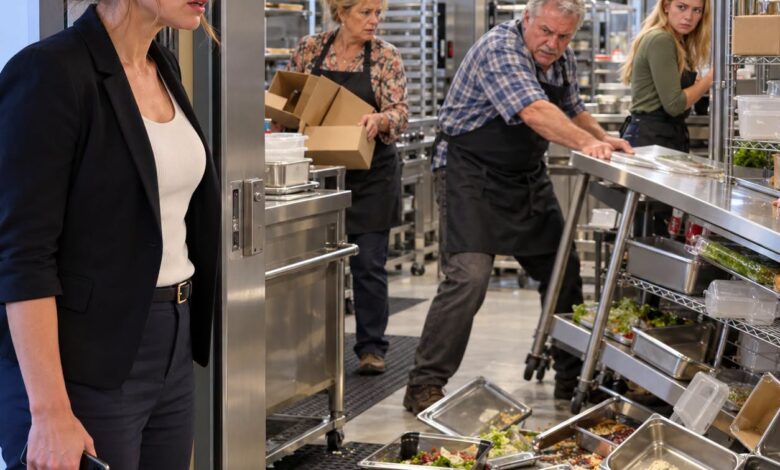
Three people were inside.
My father.
My mother.
And Samantha.
Dad was holding a tool.
Mom was carrying empty boxes.
Samantha was standing near the storage room.
Then my father shoved one of my stainless-steel prep stations.
Metal trays crashed onto the floor.
I immediately called the police.
But before they arrived, I watched my father open a cabinet containing financial records.
Samantha started photographing documents.
Then Dad shouted:
“You wanted to protect this place? Fine! Now you have nothing left to protect!”
He smashed another piece of equipment.
I saved the footage.
Every second of it.
When the police arrived, my family tried to explain themselves.
Dad claimed he was “removing family property.”
Samantha said she was “taking inventory.”
I showed the officers the security footage.
Their story changed immediately.
They were arrested for trespassing and property damage.
But the biggest discovery came when an officer searched the folder Dad had been carrying.
Inside were copies of my business records.
Bank information.
Lease documents.
Equipment lists.
Client information.
And something even more disturbing.
A draft agreement transferring ownership of my company.
My signature was already printed at the bottom.
I had never signed it.
Daniel arrived that night.
He looked through the papers.
“This is bigger than the break-in.”
He pointed to the document.
“Someone prepared a fraudulent ownership transfer.”
My stomach dropped.
“They were planning to take my company.”
The investigation uncovered the rest.
My father had given my financial information to the broker.
Samantha had contacted vendors pretending she was helping manage the company.
My parents had been negotiating with potential buyers.
And the “family plan” wasn’t really about saving Samantha.
They wanted to sell my business, pay off their debts, fund Samantha’s new company, and divide the remaining money.
They had planned everything.
They simply assumed I would eventually surrender.
The police investigation continued, and the forged documents became part of the evidence.
My parents and Samantha were later charged in connection with the break-in and the fraudulent documents.
The family meeting they had imagined never happened.
Instead, there were lawyers, investigators, and court dates.
Months later, I stood inside my kitchen after everything had been repaired.
The broken equipment had been replaced.
The security system was stronger.
My employees were still there.
And the company was still mine.
One evening, Samantha called me.
Her voice sounded different.
“I didn’t think it would go this far.”
I closed my eyes.
“You didn’t think destroying my business would go too far?”
“We were desperate.”
“You weren’t desperate enough to ask for help honestly.”
She was silent.
Then she whispered:
“Do you really hate us?”
I looked around the kitchen.
“No.”
She waited.
“I don’t hate you.”
I took a breath.
“But I don’t trust you anymore.”
That was the truth.
And sometimes the truth is more final than anger.
A year later, my company was stronger than ever.
We had expanded into corporate events and opened a second commercial kitchen.
I also started a small scholarship for young culinary entrepreneurs who couldn’t afford the equipment needed to begin.
The first recipient was a young woman who reminded me of myself at twenty-five.
When I handed her the check, she cried.
I told her:
“Build something that belongs to you. And never let anyone convince you that your hard work is something they can simply take.”
My family had tried to teach me that being loyal meant sacrificing everything for people who demanded it.
Instead, they taught me something else.
Family is not an excuse to control you.
Love doesn’t require surrender.
And helping someone doesn’t mean destroying yourself to save them.
My parents wanted me to sell the business because they thought I would eventually choose family over everything I had built.
They were right about one thing.
I did choose family.
I just finally realized that I was part of that family too.