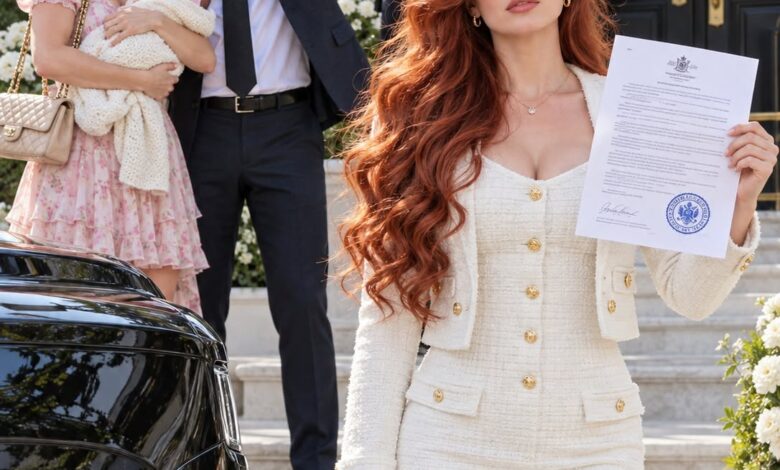
The very day I signed the divorce papers, I canceled the $4,000 I had been depositing into my mother-in-law’s account every month. My husband had told me, “My lover and our baby will stay in the house. You can leave.” I didn’t argue. I packed my things and called my lawyer. Days later, he returned to our mansion in Miami with his mistress and the child, but what he found at the entrance left him completely speechless.

My father tossed my suitcase onto the roadside and set it on fire.
I was only thirteen.
We were driving along a deserted country road when Dad suddenly pulled over, opened the trunk, and threw my suitcase onto the ground.
“Get out.”
At first, I thought he was joking.
Then he scattered my clothes across the dirt and poured gasoline over my suitcase.
“Dad, what are you doing?” I screamed.
He struck a match and dropped it.
Within seconds, flames swallowed everything I owned.
“You’re no longer my family,” he said coldly. “Never come back.”
My mother sat in the passenger seat, staring straight ahead. She wouldn’t even look at me.
My younger brother, Ethan, watched through the back window as our father started the engine.
Then they drove away.
I stood barefoot beside the road, watching the smoke rise from the remains of my belongings. I had no phone, no money, and no idea where I was.
Eventually, a passing motorist stopped and contacted the authorities.
When an officer asked whether I wanted to go home, I swallowed my tears and shook my head.
“I don’t want to go back,” I whispered. “Not after what my father just did.”
I stayed with relatives for a while before eventually entering foster care. I never contacted my family again.
The years passed, and I built a life of my own.
But the memory of that night never completely disappeared.
Then, twenty years later, a wedding invitation arrived in my mailbox.
My younger brother, Ethan, was getting married.
I almost threw it away. But inside the envelope, I found another letter written in my mother’s familiar handwriting.
Six words were written across the front:
“Please read this before the wedding.”
I opened it.
The first sentence made my hands tremble.
“Your father lied to you that night.”
I read those words again and again.
Then I continued.
My mother explained that my father had accused me of stealing $900 from his wallet. He had told our relatives that I was dishonest, rebellious, and impossible to control.
But I had never stolen anything.
The money had actually come from my mother. She had secretly given it to me to buy food because my father had stopped providing enough money for groceries.
When he discovered what she had done, he twisted the situation into an accusation against me.
But that wasn’t the real reason he had abandoned me.
The next paragraph changed everything.
“Your father had been withdrawing money from Grandma’s account. You discovered the statements.”
Suddenly, I remembered.
When I was thirteen, I had found several envelopes in my father’s desk. They contained bank statements bearing my grandmother’s name.
I didn’t understand every detail, but I noticed that large amounts of money were disappearing from her savings.
I questioned my father about it.
His face had changed immediately.
He accused me of snooping, lying, and trying to destroy the family. After that, he began treating me as though I were his enemy.
Now, twenty years later, my mother was finally admitting the truth.
“I was afraid of him,” she wrote. “I should have protected you, but I stayed silent. I know that my fear does not excuse what I did.”
I paused, struggling to breathe.
For years, I had wondered what I could possibly have done to deserve being abandoned by my own parents.
Now I knew that I had done nothing wrong.
My mother continued explaining why Ethan had sent the invitation.
While preparing to clear out the family home before his wedding, Ethan had discovered our grandmother’s old lockbox. Inside were duplicate bank statements, handwritten notes, and several sealed letters.
One of those letters was addressed to me.
Grandma had discovered the unauthorized withdrawals and intended to confront my father. She had preserved evidence because she feared he might destroy it.
Then I reached the sentence that frightened me most.
“Ethan knows your father has been dishonest. Your father knows Ethan found the box.”
I immediately called my brother.
He didn’t answer.
A minute later, a message appeared on my screen.
“Don’t visit the house. Dad knows the letter reached you.”
My heart began pounding.
I called him again. This time, he answered in a whisper.
“Ethan, what’s happening?”
“Dad wants the documents back,” he said. “He’s been demanding them ever since he discovered the lockbox was missing.”
“Then why invite me to your wedding?”
There was a long silence.
“Because I can’t begin my marriage pretending our family didn’t destroy my sister’s childhood.”
His words brought tears to my eyes.
For twenty years, I had believed my little brother had simply watched me disappear without understanding what happened.
Now I realized he had grown up carrying pieces of the same painful truth.
He told me that Grandma had written letters to all three of us. She had hidden them because she feared our father would destroy them if he discovered what she knew.
Ethan had found the box three weeks earlier.
“Grandma wanted you to know that you weren’t the problem,” he said. “I think she knew you would spend your whole life wondering.”
I couldn’t speak.
The next morning, we met near the church where his wedding would take place.
Ethan arrived carrying a small brown box.
He placed it on the table between us.
“I’m sorry,” he said.
“For what?”
“For not finding you sooner. For not knowing the truth. For everything you went through while I was growing up with them.”
I reached for his hand.
“You were a child too, Ethan.”
He nodded, his eyes full of tears.
Then I opened the box.
Inside were copies of bank statements, photographs of financial records, and Grandma’s handwritten notes.
At the bottom lay a sealed envelope bearing my name.
I recognized her handwriting immediately.
My fingers trembled as I opened it.
The first sentence read:
“If you’re reading this, the truth has finally outlasted his lies.”
I covered my mouth.
Grandma explained that she had confronted my father about the missing money. He had denied everything and accused her of forgetting her own finances.
She had intended to contact an attorney, but after suffering a stroke, she could no longer manage everything herself.
Before her health deteriorated, she carefully documented what she had discovered.
She also wrote about my mother.
Mom had begged Grandma not to involve the authorities because she was terrified of what my father might do.
Reading that hurt almost as much as remembering the roadside.
I understood that my mother had been afraid. But I also understood that her silence had left me alone when I needed her most.
The final page contained one simple message:
“Never allow him to convince you that any of this was your fault. You were a child. The adults were responsible for protecting you, and they failed.”
I broke down crying.
For twenty years, I had carried shame that never belonged to me.
Now, for the first time, I could put it down.
But the documents revealed something else.
My father had not only withdrawn money from Grandma’s savings. He had also attempted to use her former property as security for a private loan, despite not legally owning it.
Ethan feared our father planned to pressure our mother into signing documents that would transfer the property into his control during the wedding gathering.
We took everything to an attorney.
After reviewing the evidence, he advised us to preserve the original records and challenge the proposed transfer through the proper legal channels.
For the first time, my father could no longer rely on fear and silence to control the story.
The wedding was the following day.
I considered staying away. I had spent twenty years avoiding the people who had hurt me, and I wasn’t sure I could face them again.
But Ethan deserved to have his sister beside him.
And I deserved to stop being afraid of a man who had spent my childhood making me feel powerless.
So I went.
When I arrived at the church, my father was standing near the entrance.
The moment he saw me, his expression hardened.
“You shouldn’t be here,” he said.
I looked directly into his eyes.
“You told me that twenty years ago.”
His jaw tightened.
“You don’t understand what happened.”
“Then explain it,” I replied. “Tell everyone why you left a thirteen-year-old girl alone beside a country road.”
He said nothing.
My mother stood behind him, crying quietly.
Before my father could respond, Ethan approached us.
“Dad, this stops today.”
My father stared at him in disbelief.
“You’re taking her side?”
Ethan shook his head.
“I’m standing with the truth.”
Our attorney arrived carrying copies of the relevant documents. A process server accompanied him to deliver the appropriate legal papers.
My father’s confidence began to disappear.
He had spent years controlling what our relatives believed about me. He had portrayed me as a thief and a difficult child, allowing everyone to believe that my abandonment had been justified.
Now the evidence told a different story.
My mother stepped forward.
“I should have protected her,” she said.
My father turned toward her angrily.
“You never said anything before.”
“I know,” she answered through her tears. “And I have to live with that.”
Then she looked at me.
“I was wrong. I’m sorry.”
I had imagined hearing those words countless times.
I thought I would immediately embrace her, finally feeling that the pain of my childhood had been repaired.
But standing there, I realized an apology could not return the years I had lost.
I nodded slowly.
“I hear you,” I said. “But I need time.”
She lowered her eyes and accepted my answer.
The wedding proceeded without a public confrontation.
Ethan married the woman he loved, and I sat among the guests, feeling something I hadn’t felt in years: a sense of belonging that didn’t depend on my father’s approval.
Before the ceremony began, my brother hugged me.
“I’m glad you came,” he whispered.
I held him tightly.
“So am I.”
Over the following months, the legal proceedings continued. Our attorney challenged the proposed property transfer and helped preserve Grandma’s evidence.
Eventually, my father returned the recoverable funds and surrendered his claim to the property through a legal settlement.
For the first time, his decisions had consequences he couldn’t simply explain away.
My relationship with my mother developed slowly.
We met occasionally for coffee. Sometimes we talked about ordinary things. Other times, we discussed the past.
She never asked me to pretend that nothing had happened.
And I never promised that everything would return to the way it had been.
I could understand her fear without pretending her silence hadn’t hurt me.
Meanwhile, I continued building the life I had created without my family.
I developed my career, bought a modest home, and surrounded myself with friends who valued me for who I was.
I stopped measuring my worth by whether my father approved of me.
Grandma’s letter remained in a locked drawer beside my most important documents.
Whenever old memories resurfaced, I reread the final page.
“You were a child. The adults were responsible for protecting you.”
Those words reminded me of what I had spent twenty years struggling to understand.
I had never deserved what happened to me.
My father’s decision had not been discipline. It had not been a reasonable response to a difficult child.
It had been abandonment.
And surviving it did not mean I had to forgive him, welcome him back, or pretend that his actions were acceptable.
It meant I could finally move forward without carrying the blame.
Sometimes I wondered what my life would have been like if my father had chosen kindness instead of cruelty. Perhaps we could have been a normal family. Perhaps my mother would have found the courage to speak sooner. Perhaps I would have grown up knowing that home was a place where I was safe.
But those possibilities belonged to the past.
I could not change what had happened beside that country road.
I could only decide what happened next.
My father once looked at a frightened thirteen-year-old girl and told her she was no longer his family.
For twenty years, I believed those words had the power to define me.
They didn’t.
The wedding invitation had brought me back to a family I thought I had lost forever, but it also gave me something more important than reconciliation.
It gave me the truth.
I learned that my grandmother had believed me, even when she could no longer protect me. I discovered that my brother had never stopped caring. And I finally understood that my mother’s fear explained her silence, but it did not erase the consequences of it.
Most importantly, I stopped believing that the worst thing my father had ever said about me was true.
I was never worthless.
I was never the problem.
I was simply a child who deserved protection.
Twenty years after my father burned my suitcase beside that lonely road, I no longer saw myself as the girl who had been rejected.
I saw a woman who had survived, built a life, and found the courage to face the truth.
My family had changed forever. Some relationships healed, others remained distant, and some wounds never completely disappeared.
But I was finally free to decide who belonged in my life.
And that freedom was worth more than any apology my father could ever offer.
He once told me, “You’re no longer my family.”
Twenty years later, I finally understood the truth.
I had never lost my worth.
And no one—not even my own father—could ever take it away from me.